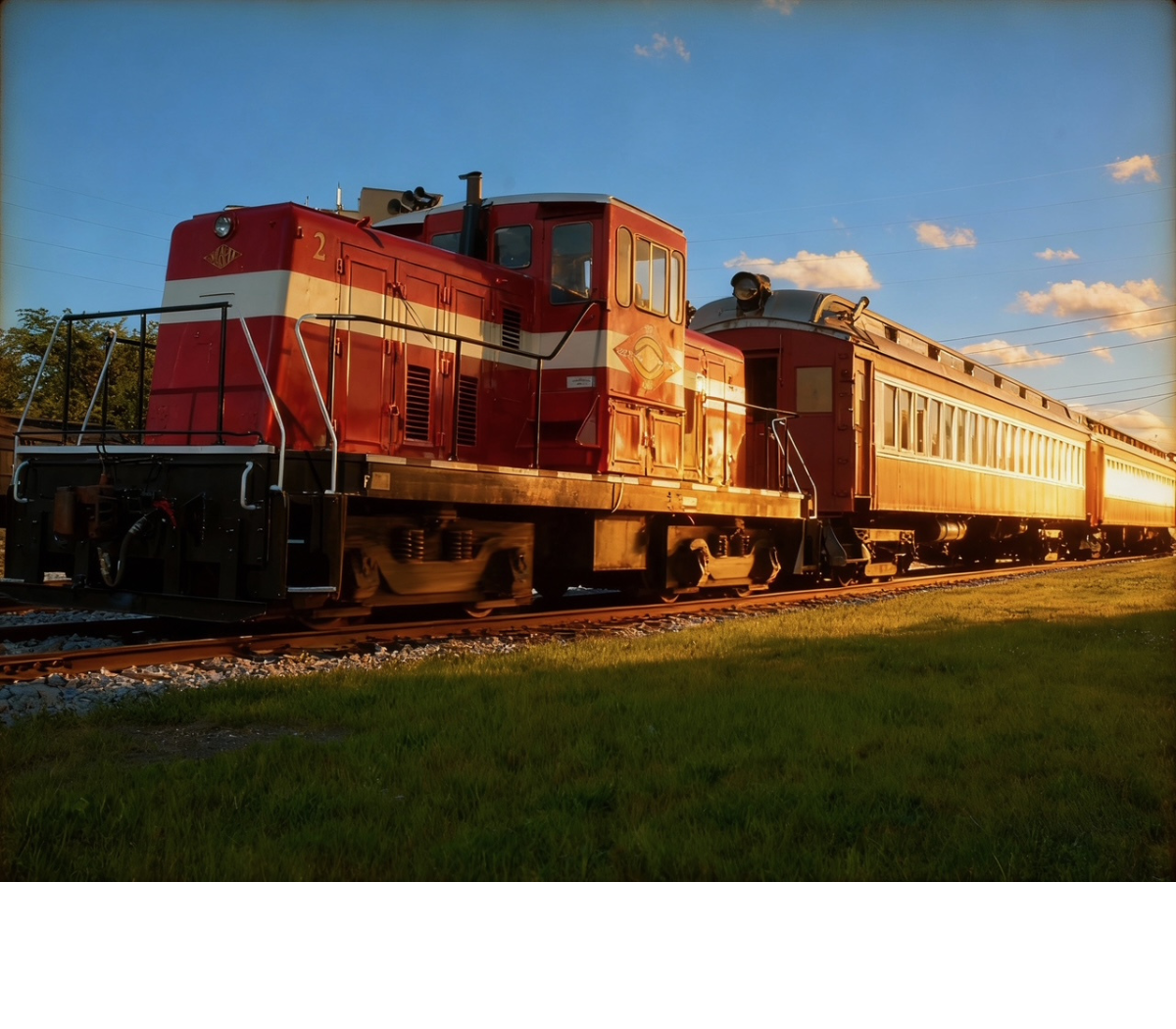
Thinking Back On 2010

Thank you!

As we wrap up 2010 we wish to say a big thank you to all the customers, workers, and volunteers that helped make this a good year. We were able to have

This year we also:

  • restored a passenger car,
  • cleaned up a lot of the yard for our transload project, and
  • re-gauged the Red Arrow Trolley and put it in the shop for further restoration.

We look forward to an even better year in 2011.


Share

Come Ride A Trolley!

In 1984 Mr. Wendell Dillinger bought the 441 Rio De Janiero Tram/Rio JT from The Fox River Trolley Museum in South Elgin, Illinois. This trolley was built in 1909.

In May 2007 it looked liked this:


By August of 2007 it was well into the restoration process. Here’s the newly restored inside:

In October of 2007 it was out of the barn and on the tracks again!

Since then it has been used for special occasions including the Middletown Autumn fests.

If you have never had the pleasure of riding in an open trolley you should come visit. Come hear the clang, clang, clang of the trolley!

Share

Restoring A Passenger Car

This is a Chicago made Pullman car from 1916 that was showing it’s age.

Ready to remove old heaters under seats

It became the big project for the winter of 09-10. [Read more...]

Share

How Did It Get The Nickname Milk & Honey Railroad?

Benjamin L. Bernhart, who is the Reading Railroad Museum curator, wrote an article for the January 2010 issue of Reading Railroad Magazine. It is titled Moving Milk on the Reading and gives us another clue into why the M&H is sometimes referred to as the milk & honey railroad. Following is an excerpt from that article:

May05

Milk operations were at their height between 1910 and 1920. The Reading Railroad was moving between 3000 and 4000 cans daily. Every day, early in the morning, a special milk train left Harrisburg for Philadephia. The train began its journey with cars of milk gathered from the Gettysburg Brand and the PH&P Branch that morning.

Additional milk was taken on at the junction of the Middletown & Hummelstown Branch, just west of Hershey.

Milk cars were added at Lebanon from the Lebanon & Tremont Branch. At Reading, milk cars were added from the Reading and Columbia Branch, Wilmington & Northern, Schuylkill & Lehigh, and the East Penn Branches. East of Reading milk was added at Douglasville, Phoenixville, and the Pickering Branch finally arriving at 3rd & Berks Streets in Philadelphia late that night for process and sale in Philly the next morning. So think of the Reading Railroad as a big river of milk stretching from Harrisburg to Philly with tributary streams like the M&H.

Share

Wood Box Car

M&H Railroad Boxcar 2009

Photo by Jeb Boyd, Whiskey Spring Studios

Built prior to 1890, this car has a wood frame, link and pin couplers and hand brakes.

George Westinghouse’s air brake invention was first used on passenger trains in 1868; freight cars came much later. On a signal from the engineer, the brakeman jumped from car to car setting the hand brakes.

To couple the cars, the brakeman had to slip a pin down through the hole in the coupler and through the link as the cars slammed together. All this was done, night and day, in all kinds of weather. Railroading in the “good old days” was an extremely hazardous occupation. Many men were seriously injured or killed.

Truss rods under the car were periodically tightened to keep the car from sagging in the middle.

The box car in the picture is owned by Middletown & Hummelstown Railroad.

Share

Middletown & Hummelstown Railroad

Share

Middletown & Hummelstown Railroad

Share